Future Circular Collider Meeting in Rome
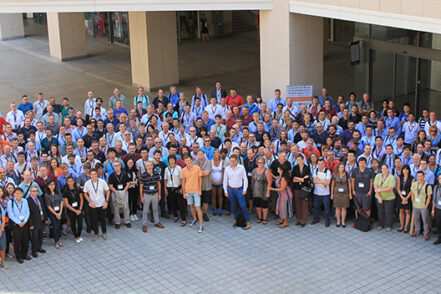
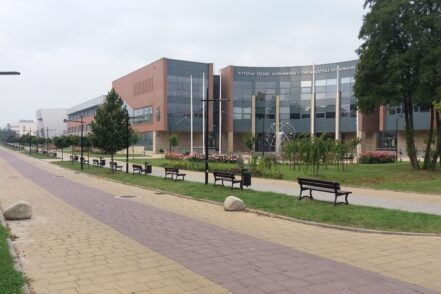
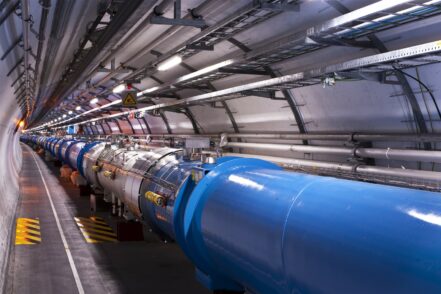
The second Annual Meeting of the Future Circular Collider study will take place from 11 to 15 April 2016 in Rome. The meeting brings together the world’s leading scientists and…
Laser self-mixing is a technique usually used for the measurement of low velocities and vibrations. In a paper that has just been published in the journal Nuclear Instruments and Methods…
Particle accelerators find many applications in fundamental research, as well as in health, energy and security applications. They range from relatively compact, sometimes even table top devices to km-size particle…
Based on the work developed within QUASAR group at the Cockcroft Institute a new ltd company D-Beam has been established to commercialise some of the results. D-Beam ltd provides optical…
High energy particle beams with extreme luminosities and ultra-bright beams of energetic radiation are ubiquitous tools for studying the structure of matter in a wide range of spatial and temporal…
In time for the global launch of the latest Star Wars movie “The Force Awakens” LA3NET Fellow Thomas Hoffmann (CERN) and oPAC Fellow Konstantin Kruchinin (Royal Holloway University of London)…
The weekly political and cultural magazine New Statesman has just published an article by Prof. Carsten P. Welsch highlighting the risks that a shortage of trained accelerator scientists poses on…
Last June saw the start of the EU-funded EuroCirCol project, a design study for a post-LHC hadron collider in which the Cockcroft Institute is playing an important role. The…