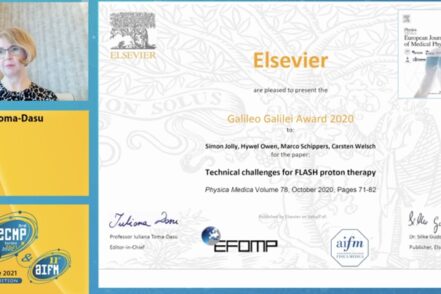
New paper on pioneering new cancer radiotherapy
FLASH radiotherapy is a promising new technique that uses high-energy particles to treat tumours; a high dose of radiation is administered almost instantaneously – in milliseconds rather than around a…
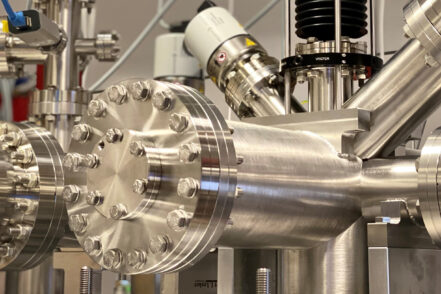
The QUASAR Group, based at the Cockcroft Institute/University of Liverpool, and UHV Design Ltd (UHVD), a leading specialist in UHV motion and heating products, have formed a new partnership that…
On 9th September 2020, the Italian government submitted an application to include the European Plasma Research Accelerator with Excellence in Applications (EuPRAXIA) in the European roadmap for large research infrastructures.…
The EU-funded ARIES proof of concept project Innovative Adaptive Optics has recently drawn to a close. This project saw a collaboration between the QUASAR Group from the University of Liverpool/Cockcroft…
A new STFC-funded project for developing an advanced machine protection system based on optical fibre technology was started this month by the QUASAR Group, based at the Cockcroft Institute. Research…
CI researchers work on particle accelerators which are some of the largest structures in the world – the LHC at CERN is 27 km around and there are plans for…
Pavel Juarez-Lopez joined the Cockcroft Institute in October 2016 as a Ph.D. student jointly appointed by the University of Liverpool and ASTeC to research the performance of photocathode electron sources…
Prof Graeme Burt has taken over from Dan Faircloth as the chair of the Particle Accelerator Engineering Network. The network is jointly supported by IET, IMechE, IoP and STFC but…
In the context of the current global Covid-19 pandemic, interfacing, interactions and collaborations are most certainly being challenged in terms of groups finding ways to maintain ongoing and effective engagements.…