
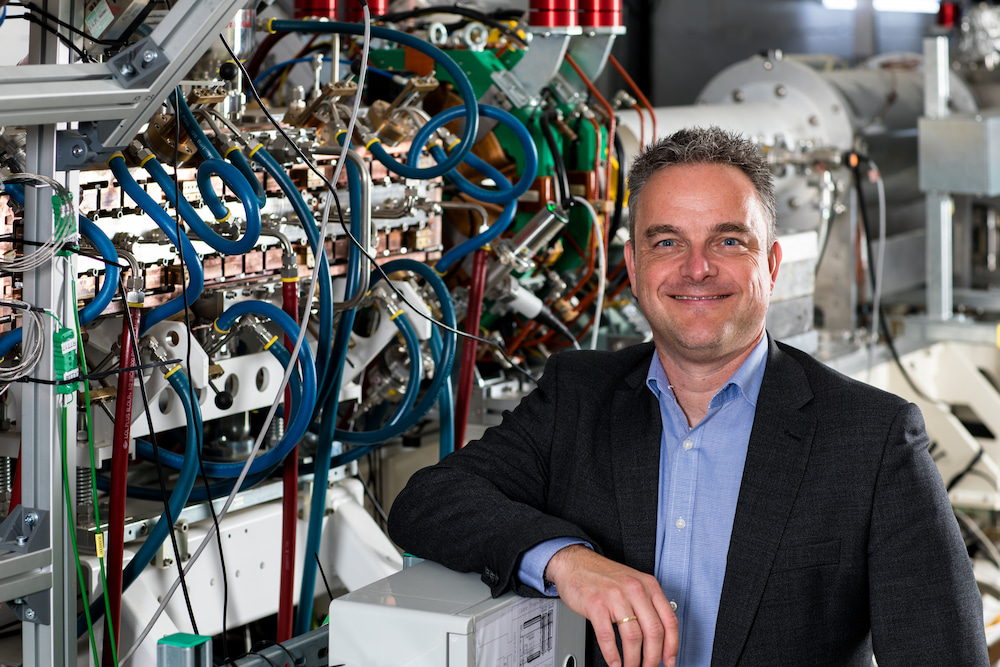
Professor Carsten P Welsch, Head of Accelerator Science at the University of Liverpool and leader of the QUASAR Group based at the Cockcroft Institute, has been awarded an Alexander von Humboldt Professorship, Germany’s most highly endowed research award.
The award recognizes Prof Welsch’s outstanding contributions to accelerator science and technology and opens up opportunities to establish an internationally leading research program in sustainable particle accelerators and medical technologies at the Karlsruhe Institute of Technology (KIT).
The Alexander von Humboldt Professorship provides internationally leading researchers working outside Germany with exceptional funding and long-term opportunities to develop highly ambitious research programs.
Prof Welsch said: “I am delighted to receive this award, which also recognizes the work of my group and our international partners. The Humboldt Professorship opens up unique scientific opportunities. In particular, the possibilities that could arise from bringing accelerator physics, digital technologies and medical applications closer together at KIT are exceptional.”
A member of the Cockcroft Institute since 2008, Prof Welsch has made significant contributions to the development and optimization of particle accelerators, with a particular focus on novel beam instrumentation and diagnostics.
For two decades, he has led the development of the Beam Gas Curtain Monitor for the Large Hadron Collider (LHC) at CERN. The collaboration was awarded the Faraday Cup Award earlier in 2026. He was also a co-recipient of the Galileo Galilei Award in Medical Physics in 2021, together with colleagues from the UK and Switzerland.
The potential research program at KIT would build on existing accelerator facilities and expertise in physics, computer science, energy research and medical technologies. Its ambition would be to make particle accelerators more precise, energy-efficient and versatile, addressing challenges in fundamental science, materials research and medicine.
Potential research areas include the development of digital twins for accelerator facilities, enabling the early identification of operational issues and the optimization of energy consumption. Novel beam and dose measurement techniques could also support further advances in proton and ion beam therapy for cancer treatment.
In addition to his research achievements, Prof Welsch has coordinated ten European research projects, including six major Marie Skłodowska-Curie research and training networks, and published more than 200 scientific papers. His international leadership in researcher training has made an important contribution to developing the next generation of accelerator scientists and engineers.
The award is a fantastic recognition of the research excellence of Prof Welsch and his group and highlights the importance of international collaboration in addressing future scientific, technological and societal challenges.
Congratulations!