
Professor Carsten P Welsch, Head of Accelerator Science at the University of Liverpool and Head of the QUASAR Group, based at the Cockcroft Institute, delivered the opening keynote at the MSCA UK30 anniversary event, held at the Royal Society in London on 20–21 October 2026.
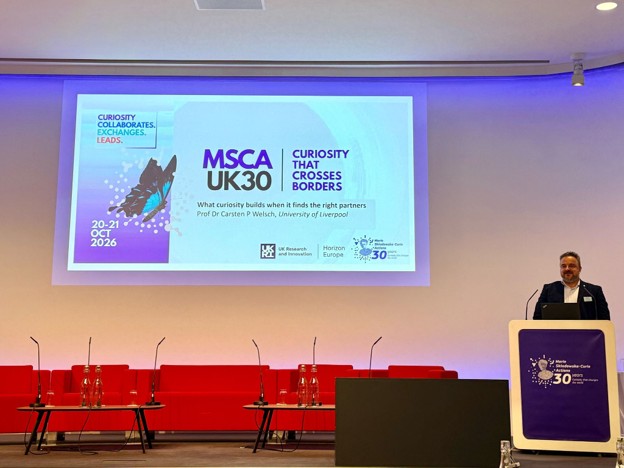
Organized by UK Research and Innovation (UKRI), MSCA UK30: Curiosity That Crosses Borders celebrated three decades of Marie Skłodowska-Curie Actions (MSCA), a flagship European program supporting researcher mobility, international collaboration and career development. The event brought together researchers, university leaders, policymakers and industry representatives.
In his keynote, “What curiosity builds when it finds the right partners“, Professor Welsch highlighted how international mobility and collaboration drive scientific discovery and researcher development. Drawing on his career across Germany, the United States, Japan, CERN and the UK, he reflected on the importance of crossing geographical and disciplinary boundaries.
Professor Welsch has been involved in MSCA for almost two decades. Since establishing his QUASAR Group in 2007, he has initiated and coordinated six major MSCA research and training networks in accelerator science: DITANET, LA³NET, oPAC, OMA, AVA and the ongoing EuPRAXIA Doctoral Network.
Together, these projects have trained more than 100 Fellows and established international partnerships between universities, research centres and industry. Their activities cover advanced beam diagnostics, laser applications, accelerator optimisation, medical accelerators, antimatter research and plasma acceleration technologies.
The networks have also pioneered innovative doctoral training, combining cutting-edge research with international mobility, industrial experience and transferable skills development.
Reflecting on MSCA’s impact, Professor Welsch emphasized: “For me, its greatest success lies in the people. Seeing the Fellows develop into independent researchers and take their knowledge, curiosity and collaborations into the wider accelerator community and beyond.”
His invitation to deliver the opening keynote recognized his long-standing contribution to international doctoral training and researcher development. He highlighted the lasting value of investing in people, fostering international partnerships and enabling researchers to pursue scientific discovery across borders and disciplines.