
The 15th International Beam Instrumentation Conference (IBIC 2026) was held in Whistler, Canada this year. Dedicated to exploring the physics and engineering challenges of beam diagnostic and measurement techniques for particle accelerators worldwide it attracted almost 170 delegates from all over the world.
CI PhD students and members of the University of Liverpool’s QUASAR Group Ana Maria Guisao Betancur and Qiyuan Xu contributed to the scientific programme as invited speakers.
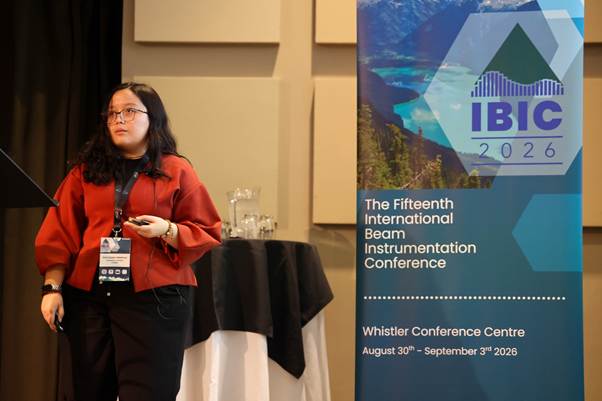
Ana, who is also a Fellow in the EuPRAXIA Doctoral Network, presented a talk titled ‘Femtosecond-resolution longitudinal bunch profile monitor using coherent transition radiation imaging’. She introduced a single-shot approach for longitudinal beam diagnostics based on broadband spatial imaging of coherent transition radiation in the THz region, combined with data-driven analysis. The diagnostic system has been installed at the MAX IV Short-Pulse Facility, where extensive experimental data have been collected and analysed.
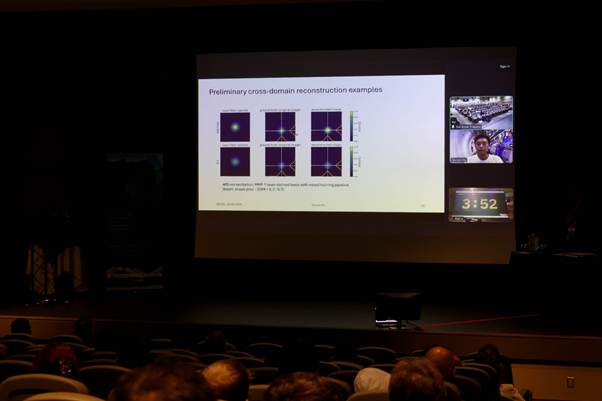
Qiyuan Xu, a PhD student within the LIV.INNO CDT, participated in the conference remotely. In his engaging presentation, entitled ‘Development of a multimode fibre system for remote transverse beam imaging at CLEAR’, he presented a system developed and deployed at CERN’s CLEAR facility for remotely imaging transverse beam distributions from a Chromox screen through a single multimode fibre to protect the cameras from radiation damage. He proposed a laser-based calibration method that constructs a response basis for generating diverse synthetic data to train a machine learning reconstruction model, without requiring beam time to collect training data.
One of the highlights of the conference was the presentation of the Faraday Cup Award. The award recognises outstanding innovation in particle beam diagnostics and instrumentation, celebrating developments that have demonstrated and published their performance.
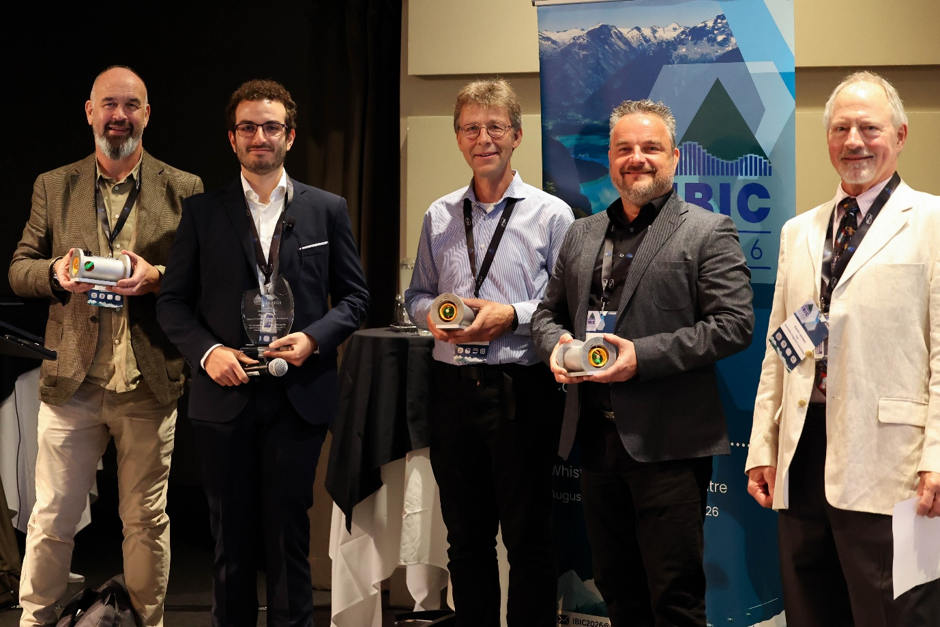
Professor Carsten P. Welsch, CI expert and leader of the QUASAR Group, received the award in recognition of his work on the Beam Gas Curtain (BGC) monitor. This innovative diagnostic instrument was developed through a long-standing collaboration between the University of Liverpool, CERN in Switzerland, and the GSI Helmholtz Centre for Heavy Ion Research in Germany.
Finally, Alexandra Welsch, a member of the CI Communications Group, supported the IBIC 2026 Local Organising Committee throughout the week as the official conference photographer.