
Christopher Arran, a lecturer at Lancaster University and the Cockcroft Institute, has been granted three years of funding from the EPSRC New Investigator Award to study the production of electron-positron pairs in the extremely strong electro-magnetic fields of high-power lasers. This interaction is thought to occur naturally in the most extreme environments of the universe, such as in pulsars and black hole accretion discs, but until now has only been measured in the world’s largest particle accelerators, at Stanford and at CERN, with much weaker electric and magnetic fields.
E = mc2 has often been regarded as the most famous equation in physics, relating energy to mass and underlying the tremendous release of energy in both nuclear fusion and nuclear fission. In these processes, an extremely small amount of mass is converted to large amounts of kinetic energy, with world-changing consequences. Now, with the world’s most powerful lasers producing light beams of unprecedented intensity, it has become possible to run the equation the other way. By focussing enough laser intensity onto high-energy gamma-rays, experiments can convert energy to mass and produce matter-antimatter pairs from pure light.
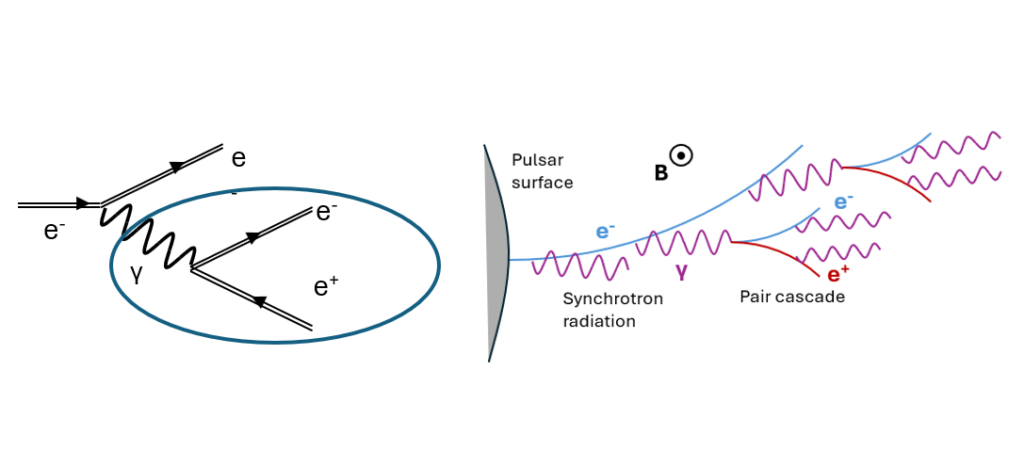
In this non-linear Breit-Wheeler process, many photons of light interact with one another to produce electron-positron pairs. In the world’s most powerful lasers, laser intensities are reaching the point where hundreds of photons can be compressed inside the radius of a single electron. Crucially, this means the photon interactions reach what is called the ‘non-perturbative’ regime, where it no longer makes sense to model the interaction as individual collisions. In Dr Arran’s words: “It’s incredibly exciting to explore the new physics unlocked by these powerful lasers, to measure the creation of matter itself from light. Because of the electro-magnetic fields are so strong, my team will study the interaction as a quantum tunnelling process: converting a ‘virtual’ electron-positron pair, a fluctuation in the vacuum, to a real measurable electron and positron. This is just what we believehappens in the most extreme environments in our universe and it’s fantastic that EPSRC have now given us the opportunity to measure these processes here on Earth.”
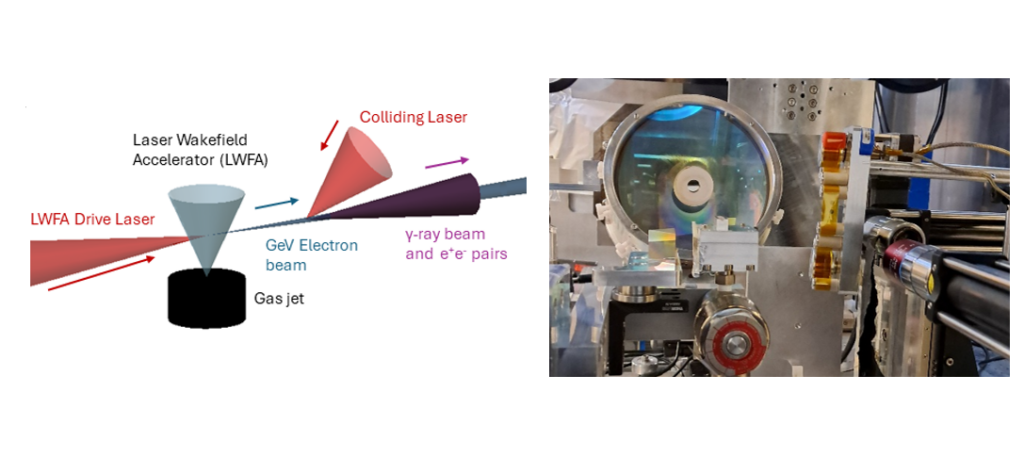
To get to this regime using high power lasers, the team will use two laser beams: one beam to make high energy electrons, using laser wakefield acceleration in a plasma; and one beam focussed to a tiny fraction of the width of a hair in order to create the highest possible intensities. By colliding the electron beam with the second laser pulse, these experiments produce both high energy gamma-rays and electron-positron pairs. Measuring all of the electron beam, the gamma-rays, and the positron pairs enables us to better understand the tunnelling process and the physics of some of the most extreme environments present in our universe. The study to make these experiments possible, particularly given challenges with timing and alignment in real laser experiments, has recently been published in the IOP’s New Journal of Physics [1].
[1] C. Arran, S. Morris, and C.P. Ridgers, New J. Phys. 28 044304 (2026), https://iopscience.iop.org/article/10.1088/1367-2630/ae57cb