
Six past and present members of the Cockcroft Institute of Accelerator Science and Technology from Liverpool and Lancaster universities are among the winners of this year’s Breakthrough Prize in Fundamental Physics, one of the world’s most prestigious scientific awards that celebrates new scientific discoveries.
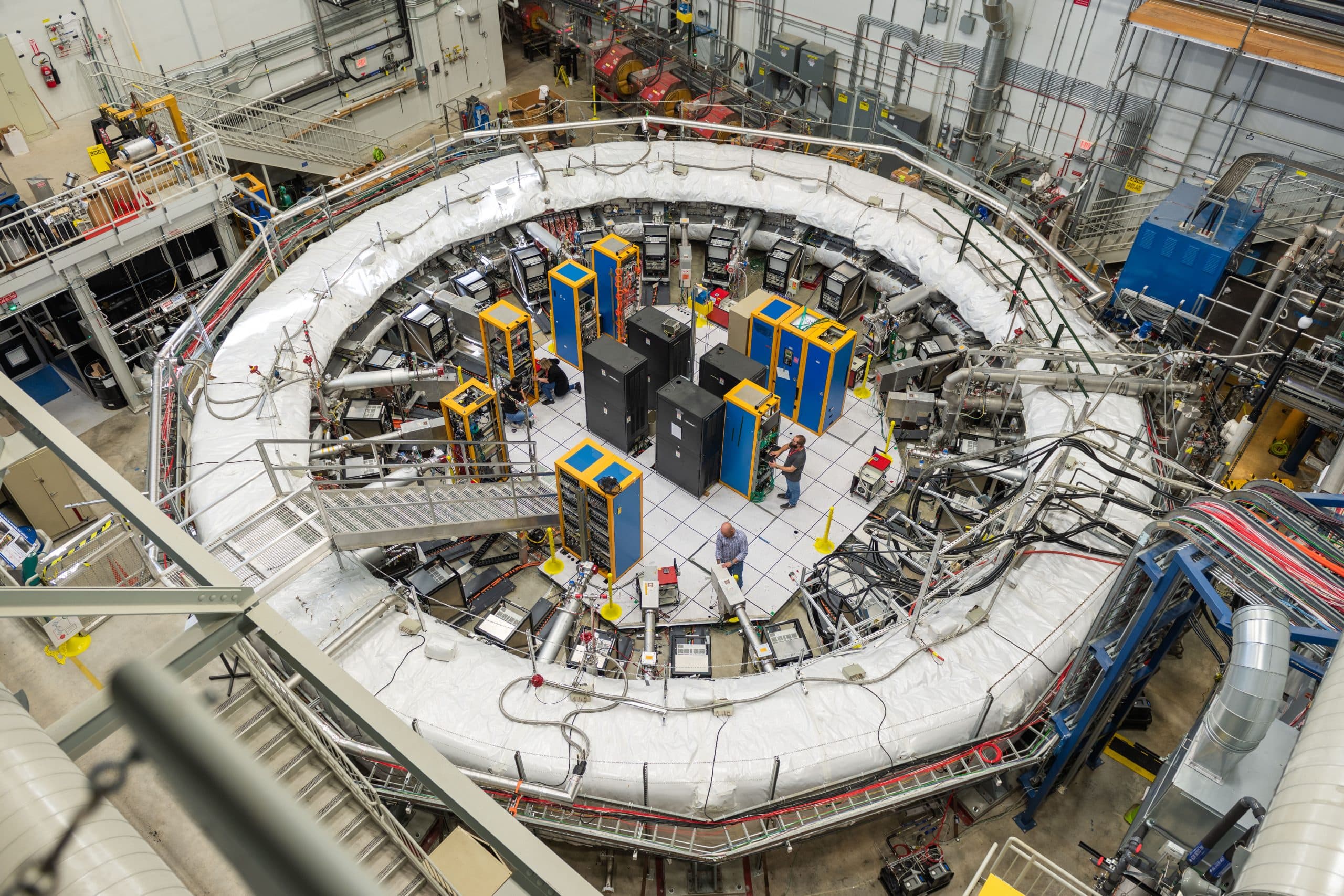
The Breakthrough Prize in Fundamental Physics was founded in 2012 by Yuri Milner to recognize those individuals who have made profound contributions to human knowledge. This year the $3 million prize has been awarded to the approximately 350 collaborators who contributed to publications reporting precision measurements of the muon magnetic moment from experiments at CERN, Brookhaven, and Fermilab. This work has provided the world’s most precise measurement of the magnetic field produced by the fundamental subatomic particle, the muon. Such measurements are extremely challenging as the magnetic field produced by a muon is roughly a trillion trillion trillion trillion times weaker than the magnetic field of the Earth.
The experiments recognised by this award began at CERN in the 1970s, shifted to Brookhaven National Laboratory in the 1990s and concluded at Fermilab with final publication in 2025. The three generations of Muon g-2 experiments were designed to measure the magnetic moment of the muon with ever-increasing precision, exploring the quantum realm where particles briefly appear and vanish—and where even tiny deviations could point to entirely new laws of nature outside of the current Standard Model of Particle Physics.
As members of the Fermilab muon g-2 experiment, some of the physicists at the Cockcroft Institute created novel computer simulations to analyse the motion of muons travelling through the particle accelerators at Fermilab. Others explored novel models for representing the complicated electromagnetic fields used in the muon storage ring where the most recent measurements took place. Throughout the lifetime of the experiment, accelerator scientists played an intrinsic role as the measurement relied on understanding the details of the muons’ trajectories.
Dr Ian Bailey, who led the Lancaster University contribution, said: “Lancaster University and the Cockcroft Institute of Accelerator Science and Technology made an important contribution to this collaboration of scientists and engineers from many different physics communities. Collectively we were able to make the most precise measurements of the muon’s magnetic moment. It’s a small but important piece of understanding how our Universe works, and it’s great to see all the hard work of the many individuals involved being recognised by the award of the Breakthrough Prize.”
The other Cockcroft Institute members awarded the breakthrough prize are Professor Andy Wolski, Dr Maxim Korostelev, Dr Eremey Valetov, Dr Alex Herrod and the late Dr David Newton who passed away in 2015.