
When the concept of mode-locking was introduced in lasers in the 1960s it allowed the laser pulse duration to be reduced by orders of magnitude. In conventional lasers mode-locking relies on the fact that the laser pulse builds up inside a physical amplifying material, such as a crystal, as it bounces back and forth inside an optical cavity made of mirrors. In the more recent X-Ray Free-Electron Lasers the amplifying material is an electron bunch travelling at close to the speed of light. This emits radiation as it wiggles from side to side in a long magnet called an undulator. The emitted radiation then stimulates the electron bunch to emit even more radiation, so that over a distance of tens of metres the radiation power grows to Gigawatt power levels. There is no optical cavity in which the X-ray intensity builds up, so the conventional method of mode-locking cannot be applied.
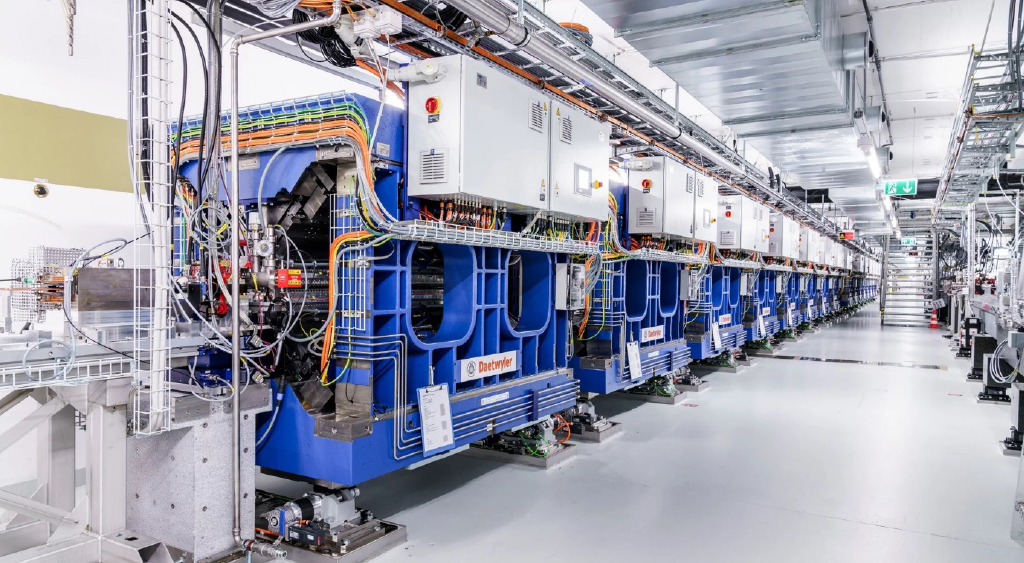
However, researchers at The Cockcroft Institute realised that mode-locking could be applied in the free-electron laser, not by manipulating the X-rays in an optical cavity, but by manipulating the electron bunch itself. They proposed adding small electron bunch delaying magnetic chicanes at regular intervals along the FEL undulator magnet – this would in effect simulate the effect of a tiny optical cavity travelling at light speed along with the X-Rays, allowing mode-locking to happen. The paper ‘Mode-Locking in a Free-Electron Laser Amplifier’ was published in Physical Review Letters in 2008 [1]. The paper predicted, through theory and simulations, that a mode-locked FEL would produce trains of high-power identical, ultrashort pulses with durations as short as tens of attoseconds in the X-ray.
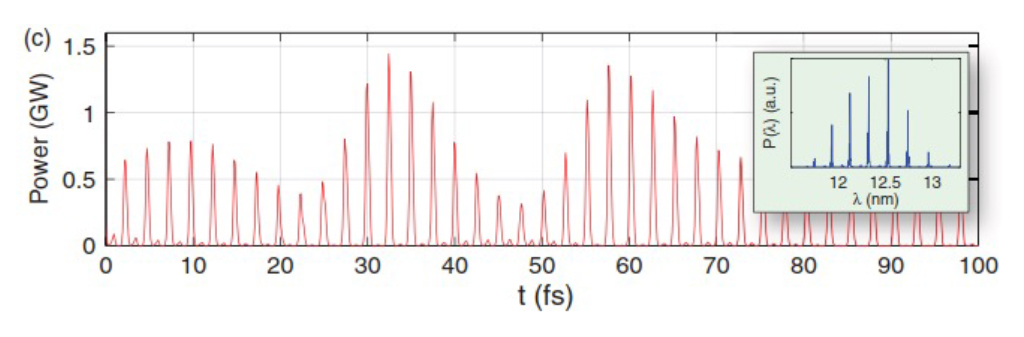
At around this time the design of Athos, the Soft X-ray FEL at SwissFEL, was being finalised at the Paul Scherrer Institute in Switzerland. The team there decided to add to the design the electron bunch delay chicanes – one of the reasons for this was so that they could offer mode-locked output to their users. Then last year the team at SwissFEL successfully demonstrated mode-locked output – Athos produced trains of evenly spaced FEL pulses each of duration a few hundred attoseconds, exactly as predicted by the theory. Measurements of the spectrum showed a clean well defined frequency comb, again as expected. The experimental results were published in Physical Review Letters at the end of 2025, with Cockcroft researchers as co-authors [2].

(adapted from [2] )
The results have gained significant interest in the physics community. As a feature article in The American Physical Society magazine ‘Physics’ explained [3]: “The availability of trains of phase-locked attosecond x-ray pulses offers striking opportunities. Powerful precision spectroscopy techniques, such as Ramsey-type interferometry, that are routine in optical physics, may now become feasible at x-ray wavelengths. By probing the energies of atomic core levels, such experiments could track, with element specificity, charge migration, spin transfer, and electronic correlations on their natural timescales. More broadly, this work signals a conceptual shift. XFELs are no longer limited to producing “the shortest possible pulses,” but are beginning to offer tailored x-ray waveforms designed to drive atoms, solids, and low-density matter through specific quantum pathways.
Just as optical frequency combs reshaped precision spectroscopy, the emergence of x-ray frequency combs may similarly transform how we probe—and ultimately manipulate—matter at its most fundamental scales.”
References
[1] N. R. Thompson, B. W. McNeil, “Mode locking in a free-electron laser amplifier,” Phys. Rev. Lett. 100, 203901 (2008).
[2] W. Hu et al., “Demonstration of mode-locked frequency comb for an x-ray free-electron laser,” Phys. Rev. Lett. 135, 265001 (2025).