
Lancaster University PhD student Dan Seal has been awarded the Harry Jones Prize by the British Cryogenic society (BSC) for 2025. The prize is given annually for the best UK thesis in the field of experimental applied science in the field of cryogenics. The prize was awarded for Dan’s thesis “Development Of A High Throughput Facility For The RF Characterisation of Superconducting Thin Films”. In his PhD Dan developed a novel facility to measure the superconducting properties of thin films developed as part of the Cockcroft Institute SRF thin films for accelerators activity by STFC-ASTeC, as well as collaborators throughout Europe enabling key insights leading to optimisation of the deposition process. Since graduating Dan has been employed by STFC-ASTeC performing further studies with the facility, as well as developing new facilities to measure at lower frequencies.
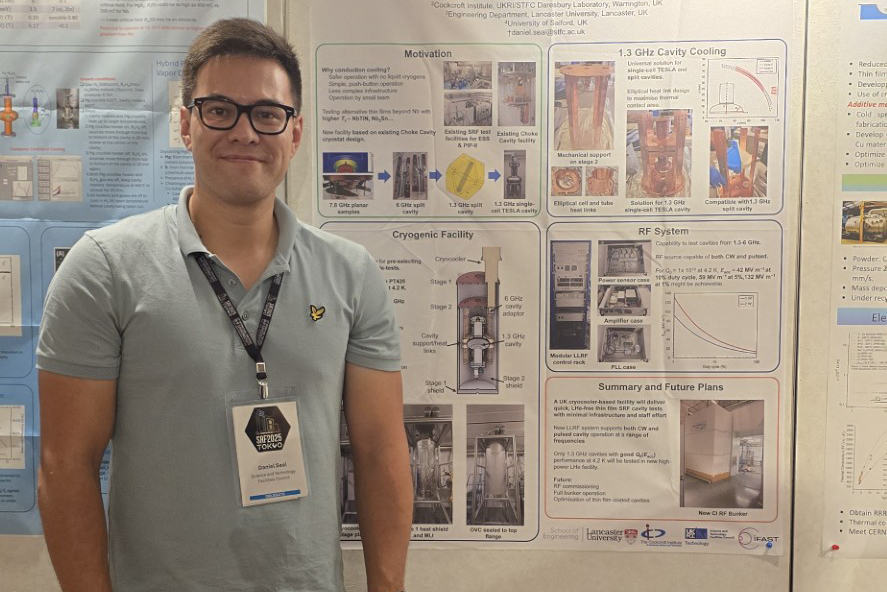
As part of the prize Dan will be giving a special seminar on the 12th February, presented in collaboration between the British Cryogenic Society (BCS) and the Cockcroft Institute at which Prof. Damian Hampshire (BCS Chair) will present the Harry Jones Prize to Dr Dan Seal for his work on superconducting thin films. Following this, Dan will deliver a seminar on his work entitled: From Bulk Niobium to Thin Films – Advancing SRF with High Throughput Cryogenic RF Characterisation. The abstract for this seminar is below.
The seminar will be in the Merrison Lecture Theatre (Daresbury Laboratory) or by Zoom:
https://zoom.us/j/94748201604?pwd=YWErNnJWK1RpUHB3RmlHNC9PSWkyZz09
The seminar will begin at 16:00, with refreshments for those attending in person available outside the lecture theatre from 15:30.
Abstract:
Superconducting radio frequency (SRF) cavities underpin many modern particle accelerators, enabling highly efficient acceleration with high duty cycle or continuous wave operation. However, this technology relies almost exclusively on bulk niobium cavities operating at around 2 K, bringing significant capital and operational costs while performance increasingly approaches theoretical limits. Thin film SRF technology offers an alternative route to more sustainable accelerators by decoupling RF performance from the bulk, enabling the use of cheaper substrates (such as copper) and alternative superconducting materials (e.g. Nb3Sn) with the potential for higher temperature operation.
This talk introduces the importance of thin film SRF and outlines the ongoing research programme at Daresbury Laboratory. During material development, tests must first be carried out on small samples, where substrate preparation and deposition parameters can be optimised before committing to full cavity tests. A key metric is the RF surface resistance, which must be measured under cryogenic conditions (3.8 – 20 K). While a small number of dedicated RF test facilities exist worldwide, many are limited by a slow sample turnover. To address this, a core element of the programme has been the development of a dedicated RF characterisation facility, designed primarily to deliver quick sample measurements. Its successful operation shows that high throughput RF characterisation is critical for accelerating thin film SRF development and guiding future cavity fabrication.