
Cockcroft Institute researchers at the University of Strathclyde have successful commissioned a laser-driven proton source platform at the Scottish Centre for the Application of Plasma-based Accelerators (SCAPA) and completed three pioneering experiments that demonstrate its growing capabilities – from space technology testing to ultrahigh dose radiobiology research and advanced machine learning. These studies showcase the transition from source development to application-oriented research.
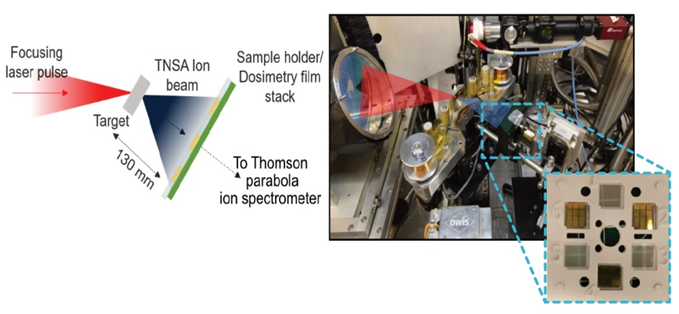
In the first study, the team tested the radiation tolerance of next-generation semiconductor devices designed for space missions. Using SCAPA’s laser-driven proton platform, they simulated four months of low-Earth orbit exposure, delivering controlled doses of 200-400 rad per device. This work, part of a UK Space Agency project, supports the development of novel materials that could replace conventional silicon-based UVC photodetectors. The platform enabled mission‑relevant radiation conditions to be reproduced rapidly and flexibly, accelerating the testing cycle for emerging space‑grade technologies.
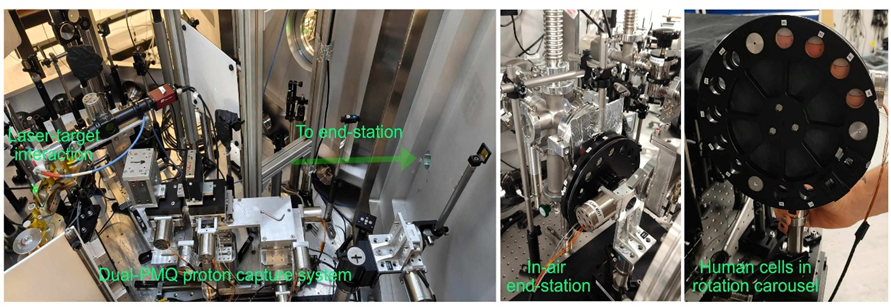
The second application experiment provided a proof‑of‑principle demonstration of laser‑driven radiobiology at SCAPA, supporting the UK’s Laser-Hybrid Accelerator for Radiobiological Applications (LhARA) initiative. The team commissioned a dual permanent-magnet quadrupole capture beamline to focus laser‑accelerated protons to an in-air end‑station. After characterising the focused proton beam, they exposed human cancer cell samples to controlled doses.
This experiment begins to validate the laser-hybrid approach at the heart of LhARA- a ground-breaking biomedical programme that aims to revolutionise cancer treatment by enabling precise, high-dose-rate radiobiology using laser-driven protons and ions. Further it represents a critical early step toward realising LhARA’s vision of a dedicated research facility that will drive advances in physics, chemistry and biology, while fostering new national and international partnerships. This experiment establishes a key milestone in SCAPA’s development, demonstrating for the first time the facility’s capability to deliver biologically relevant proton beams dose rates for cell irradiation.
In the final experiment, the SCAPA platform was integrated with an end‑to‑end machine‑learning optimisation loop operating in real time. Multiple subsystems were linked to automatically control key interaction parameters, acquire and analyse resulting beam data, and feed this information directly into a Bayesian optimisation framework. This autonomous, data-driven feedback loop enabled the system to explore a large multiple-parameter space efficiently and optimise proton beam characteristics during live shot-to-shot operation. This work showcases the capabilities of the laser-driven proton platform within SCAPA to take advantage of emerging advanced ML techniques to enhance the stability, performance and usability of laser-driven proton sources.
Together, these experimental campaigns underscore the rapid evolution and maturity of the new laser‑driven ion beamline at SCAPA – from commissioning to a versatile platform capable of cutting‑edge accelerator science and application‑driven research. The work directly supports the novel accelerator research objectives of the Cockcroft Institute’s STFC Core grant.