
The international Beam Gas Curtain (BGC) collaboration between the University of Liverpool, CERN and GSI Helmholtz Centre for Heavy Ion Research has received the prestigious Faraday Cup Award for the development of a pioneering beam diagnostic for CERN’s Large Hadron Collider (LHC).
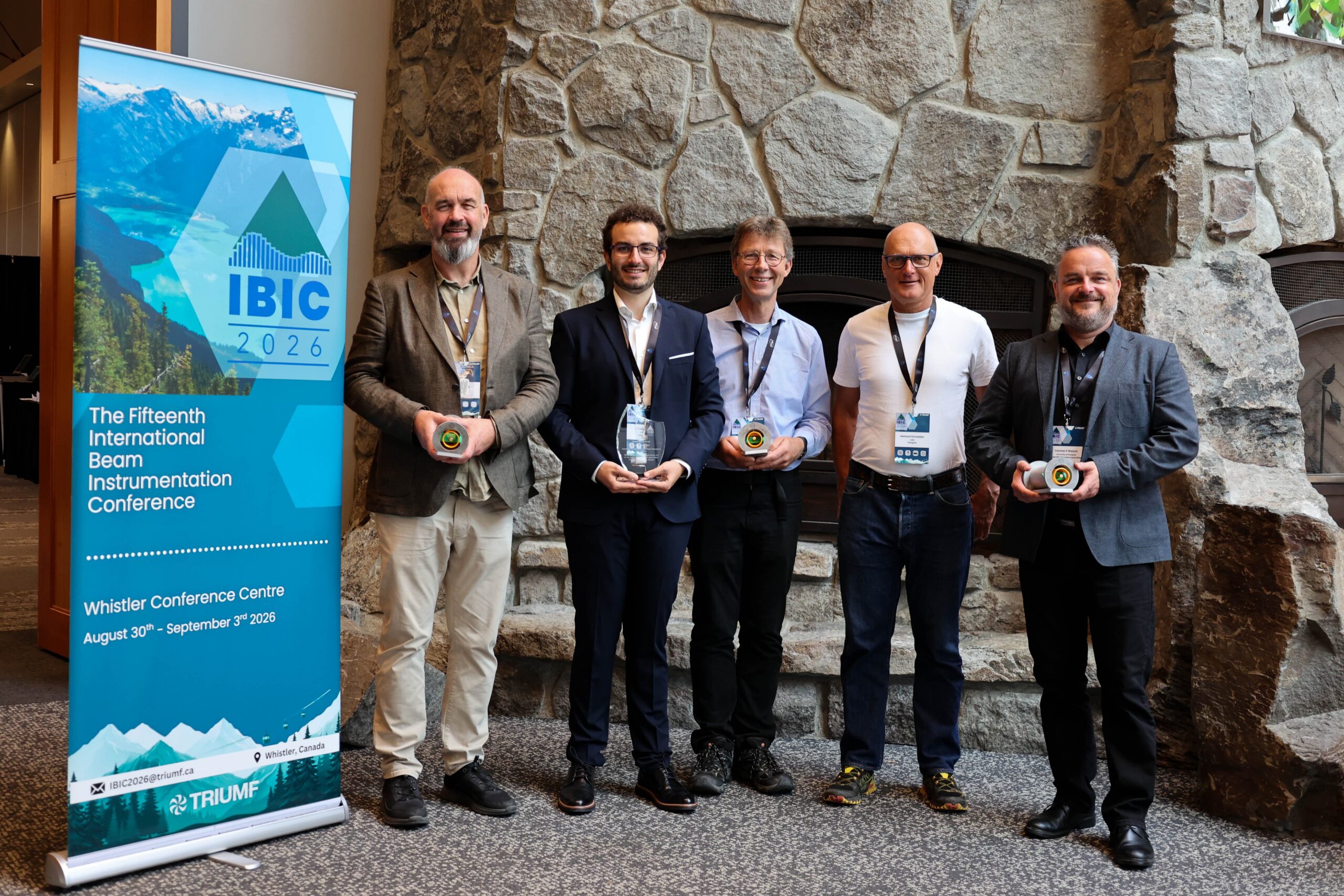
Presented at the International Beam Instrumentation Conference (IBIC 2026) in Whistler, Canada, the award recognizes outstanding innovation in particle beam diagnostics and celebrates a long-term collaborative effort that has taken the BGC from an ambitious concept to an operational instrument.
The BGC monitor addresses a major challenge in accelerator science. It allows measuring intense particle beams without significantly disturbing them. It uses a precisely shaped, ultra-thin curtain of supersonic gas to cross the beam. The resulting light signal can then be used to reconstruct the beam profile non-invasively.
Research into gas-jet-based beam diagnostics was initiated around two decades ago by Professor Carsten P Welsch, Head of Accelerator Science at the University of Liverpool and leader of the QUASAR Group. Over the past decade, this technology has been advanced through sustained collaboration between Liverpool, CERN and GSI.
At the Cockcroft Institute, the program has involved many researchers over the years. As part of the QUASAR Group, Dr Hao Zhang has played a particularly important role in the development, making major contributions to the BGC monitor and being the day-to-day contact for others researchers in the group and international collaboration partners.
Successive generations of Liverpool PhD students and postdoctoral researchers, based at the CI and at CERN, have also been central to the project, working on gas dynamics, vacuum systems, optical imaging, simulation, data analysis, control systems and commissioning. Their collective efforts have been essential in transforming the original prototype concept into a robust instrument.
The BGC installed at CERN has recently been approved for continuous operation and provides high-precision measurements of proton and heavy-ion beams across the LHC acceleration cycle. This is of central importance for machine operation and also for the upcoming High-Luminosity LHC upgrade program.
The Faraday Cup Award recognizes an important advance in beam instrumentation and in particular the collaborative model behind it. Without the long-term international partnership, sustained technical development and continued transfer of knowledge between generations of researchers, this major advance would not have been possible.
The work also has significant wider potential, with related gas-jet techniques being explored by the QUASAR Group for future high intensity accelerators, as quantum microscopes, and medical applications, including proton therapy.
Congrats!