
Researchers from the Cockcroft Institute (CI) made a strong contribution to the 11th International Conference on Charged & Neutral Particles Channeling Phenomena (Channeling 2026), held in Brindisi, Italy, from 20–25 September 2026. Organised by the Italian National Institute for Nuclear Physics (INFN)and theEuropean Organization for Nuclear Research (CERN), the conference brought together more than 110 researchers from around the world to discuss advances in particle and radiation interactions in structured media and strong electromagnetic fields, with applications in advanced accelerator technologies, beam manipulation and radiation generation.
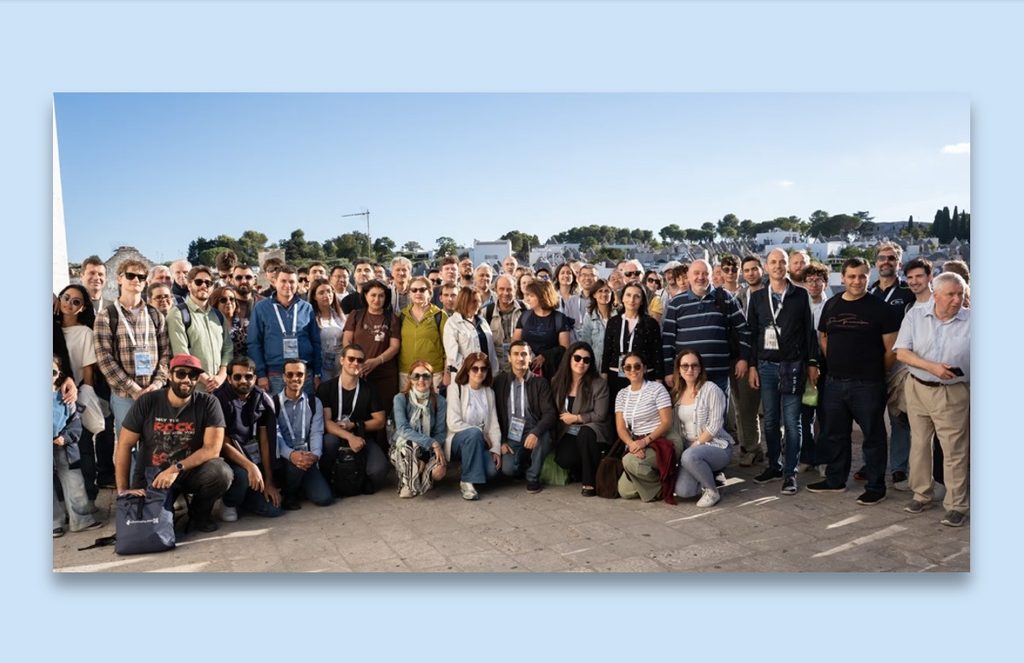
This year’s Channeling Conference also hosted the NanoAc2026 Workshop as a satellite meeting. The workshop brought together experts from plasma physics, accelerator physics, materials science, engineering, nanotechnology and other disciplines to explore the applications of nanostructured materials, including carbon nanotubes (CNTs), in accelerator physics. The workshop provided a platform for discussing emerging approaches to particle acceleration and radiation generation using nanostructured materials.
Researchers from the Cockcroft Institute contributed a series of presentations at the NanoAc2026 Workshop, covering a broad range of advanced accelerator and plasma physics research. Dr. Guoxing Xia from the University of Manchester presented an invited talk on “The Advanced Wakefield Experiment (AWAKE) at CERN: from concept to experiment and future applications” and he also served as a session chair. Other presentations from the University of Manchester included Dr. Hossein Saberi on tailoring betatron radiation through plasma density structures; PhD students Jiaqi Zhang on machine-learning-based parameter optimisation for laser wakefield acceleration in CNT targets and Shuyan Wen on the impact of longitudinal current profiles on beam loading in externally injected laser wakefield acceleration. Dr. Beifeng Lei from the University of Liverpool delivered a talk on the resonant excitation of surface plasmons for wakefield acceleration.
The conference concluded with recognition for outstanding contributions from early-career researchers. Shuyan Wen of the Cockcroft Institute received a Best Young Researcher Award for his presentation. The award, together with the contributions from the CI researchers at the NanoAc2026 Workshop, highlights the Institute’s continued engagement with the international accelerator physics community and its research into innovative approaches to next-generation particle accelerator technologies.