
Forty years after its introduction in 1985, beam-driven plasma wakefield acceleration (PWFA) has evolved from a theoretical concept and simulation study into one of the most exciting technologies for the future of particle accelerators. Over the years, new concepts have emerged, extending the field beyond electron-beam-driven wakefield schemes to include positron- and proton-driven wakefield acceleration. Many of these ideas have now progressed from theory to experimental demonstration.
A recent review article led by Dr. Hossein Saberi and Dr. Guoxing Xia from the Cockcroft Institute and The University of Manchester has recently been published in Physics Reports, providing a comprehensive overview of the evolution of particle-beam-driven plasma wakefield acceleration over the past four decades. The review introduces the fundamental concepts, underlying theory, and scaling laws that form the foundation of the field, while highlighting key milestones and landmark achievements at leading research facilities around the world. It also examines the current challenges and emerging opportunities that are shaping the future of plasma-based accelerator technology.
The review explores three principal pathways of plasma wakefield acceleration, namely electron-, positron-, and proton-driven plasma wakefield schemes. It traces the evolution of each approach from the original concepts to modern experimental demonstrations. It highlights major breakthroughs in electron-driven plasma wakefield acceleration, and the extensive experimental efforts undertaken worldwide. This work also examines the progress and unique challenges of positron acceleration, alongside the significant achievements of proton-driven wakefield acceleration, particularly through CERN’s AWAKE experiment.
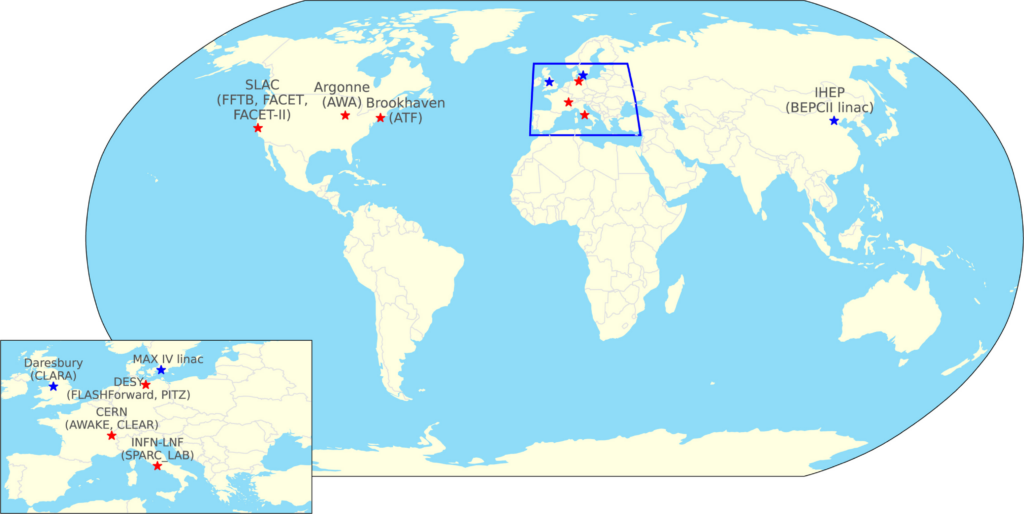
Looking to the future, the paper discusses the potential of plasma wakefield acceleration to enable next-generation energy-frontier particle colliders and compact free-electron lasers. By providing accelerating gradients far beyond those achievable with conventional radio-frequency technology, plasma accelerators have the potential to dramatically reduce the size and cost of future accelerator facilities. The review highlights recent advances in high-quality electron acceleration, plasma lenses, and emittance preservation, along with many other developments across PWFA facilities. Furthermore, the paper reviews recent progress in novel positron-acceleration concepts and proton-driven wakefield acceleration.
At the same time, it emphasises that several important challenges must still be overcome before these technologies can be widely adopted in high-energy physics experiments and advanced X-ray light sources. These include preserving beam quality and stability, mitigating beam-plasma instabilities, improving energy-transfer efficiency, overcoming the unique challenges of positron acceleration, and developing scalable plasma sources for future large-scale facilities.
The review also explores emerging research directions, including carbon nanotube-based acceleration and the growing use of machine learning for accelerator optimisation and control.
As plasma wakefield acceleration continues to advance towards real-world applications, the authors hope that this report will provide a useful reference for both new and established researchers in the field.
The significance and broad relevance of this review were further highlighted through its inclusion in the Physics Report Seminar Series, where the work was presented to a wider scientific audience and is now available to view on the Cassyni platform.
By outlining past achievements, current challenges, and future opportunities, the review paper aims to support ongoing research efforts and encourage new collaborations towards the realization of next-generation accelerator facilities.
Further details can be found in the review article:
H. Saberi et al. “Particle-beam-driven plasma wakefield acceleration: Milestones, emerging trends and future directions” Physics Reports 1199 1–50 (2026). [https://doi.org/10.1016/j.physrep.2026.07.008]
Readers can also watch a recorded presentation of the paper on the Cassyni platform at