
CI researchers have shown how two laser pulses can combine inside a microscopic tube to generate powerful accelerating fields. Their findings suggest a way to build smaller particle accelerators and bring their capabilities to more research laboratories.
The study, by CI researcher and QUASAR Group member Dr Bifeng Lei, QUASAR colleagues and international collaborators, was published in Physical Review Letters on 4 September 2026. Through analytical theory and fully three-dimensional simulations, the team shows how resonance and surface curvature can substantially reduce the laser power needed for surface-plasma wakefield acceleration.
The idea draws on a familiar experience: pushing a swing at the right moment allows a modest effort to build a large motion. This is resonance, which allows a modest driving force to build a strong response. The researchers use the same principle at microscopic scales to transfer energy from laser light into a wave of surface electrons.
In the proposed scheme, two laser pulses of different wavelengths travel together through a smooth microscopic tube. Their overlapping fields produce a repeating optical “beat” that pushes electrons along the inner surface. When this beat matches the frequency and spatial pattern of a surface plasmon – a collective oscillation of electrons at the boundary between plasma and vacuum – the surface wave grows strongly. Its electric field extends into the hollow channel, creating a wakefield capable of accelerating charged particles.
The tube’s curvature makes this possible. By changing how the surface wave propagates, it allows the laser beat and the surface plasmon to stay in step. Under the same laser conditions, this resonance cannot occur on a smooth, flat surface. The curved geometry therefore removes the need for the finely patterned gratings often used to couple light to surface plasmons. It also gives researchers a way to control these waves by shaping the surface itself.
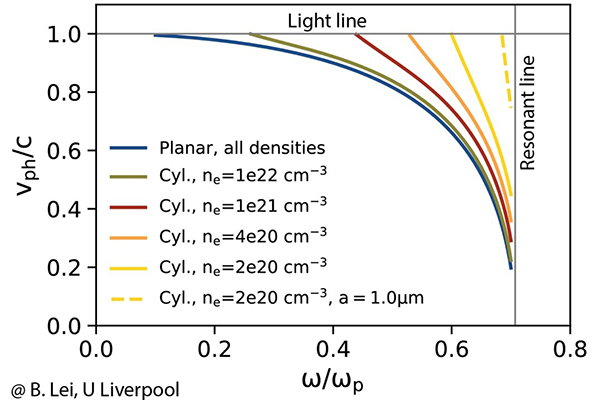
The simulations published in this paper show that laser peak powers of only a few gigawatts can generate accelerating fields of tens of gigavolts per metre, strong enough to initiate electron trapping and acceleration. At higher powers, the simulated fields reach hundreds of gigavolts per metre. In one simulation, electrons reached energies of up to 10 megaelectronvolts over just 40 micrometres. These theoretical and numerical findings provide a basis for experimental tests of the concept.
The few-gigawatt regime brings the concept within the peak-power range of compact high-power fibre lasers, suggesting a route towards systems that could be easier to accommodate in a wider range of laboratories.
Looking ahead, the approach could support miniature accelerators and radiation sources for ultrafast science, materials research and, with further development, biomedical applications. Experimental validation will need to address precise laser alignment and control of the resonance inside the microscopic channel.
By connecting the physics of resonance with the geometry of a simple curved surface, the work gives researchers a new design principle for generating strong accelerating fields, and a promising foundation for bringing accelerator capabilities into smaller spaces.
The paper, “Resonant Excitation of Surface Plasmon for Wakefield Acceleration by Beating GW Lasers on Smooth Cylindrical Surface”, is published in Physical Review Letters 137, 105002 (2026), and is available open access.