
EuPRAXIA-DN Fellows came together at the Cockcroft Institute from 29 June to 3 July 2026 for a week of hands-on challenge-based training delivered by the University of Liverpool QUASAR Group and supported by D-Beam Ltd.
The 12 Fellows were split into three teams and challenged to apply their scientific, technical and communication skills across a series of practical activities. The programme was designed to complement the Fellows’ research training by giving them experience of working outside their immediate areas of expertise.
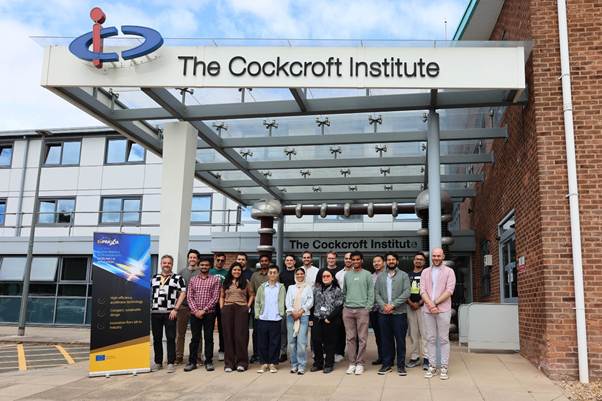
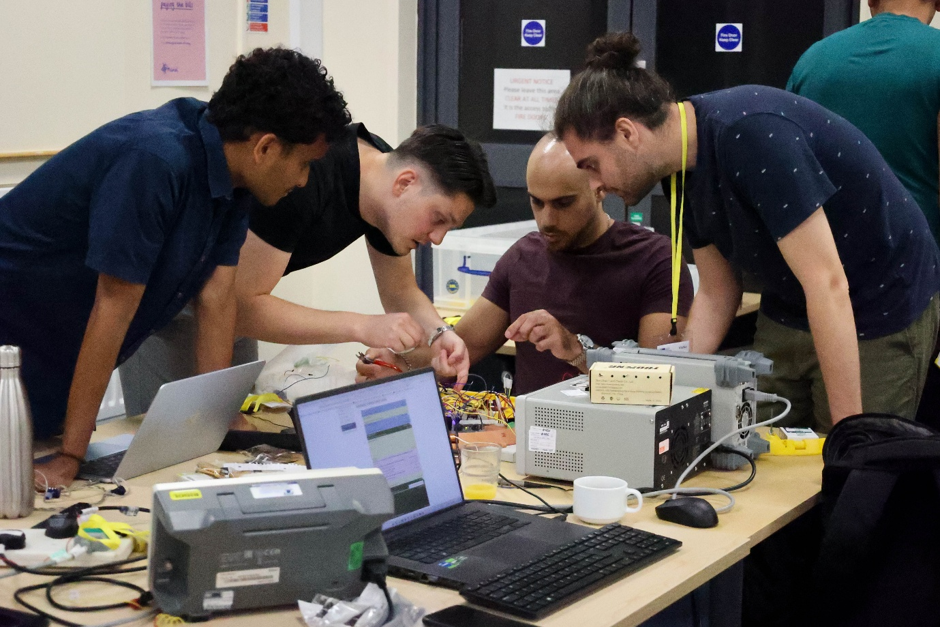
The week featured three experimental challenges, with each team tasked with developing a different scientific demonstrator. The projects covered Schlieren imaging, radio-frequency measurements of the quality factor, or Q factor, of biscuit tins, and the construction of a ball-bearing accelerator.
The Schlieren imaging challenge saw Fellows develop an optical system capable of visualising small changes in the refractive index of air. The Beam Busters team combined this with a purpose-built wind tunnel, providing an opportunity to investigate the flow around different objects and explore techniques commonly used to visualise otherwise invisible physical phenomena.
The Beam Sense team explored the principles of radio-frequency resonators through measurements of everyday biscuit tins. By investigating their resonant behaviour and Q factor, the challenge provided an accessible route into concepts that are directly relevant to RF systems and accelerating structures.
The third experimental challenge focused on a ball-bearing accelerator, giving the team GoPanthers! the opportunity to combine fundamental accelerator physics with practical problem solving and experimental optimisation.
Alongside the experimental work, the teams were given a reinforcement-learning challenge in which they competed to develop the best-performing agent for an accelerator optimisation task. This introduced the Fellows to a rapidly developing area of accelerator research, where artificial intelligence and machine-learning techniques are increasingly being investigated for applications ranging from machine tuning to autonomous control.
Communication and outreach were also an important part of the programme. The Fellows were challenged to turn their technical work into engaging demonstrations and short videos, requiring them to think not only about whether their experiments worked, but also about how they could explain the underlying science to a wider audience.
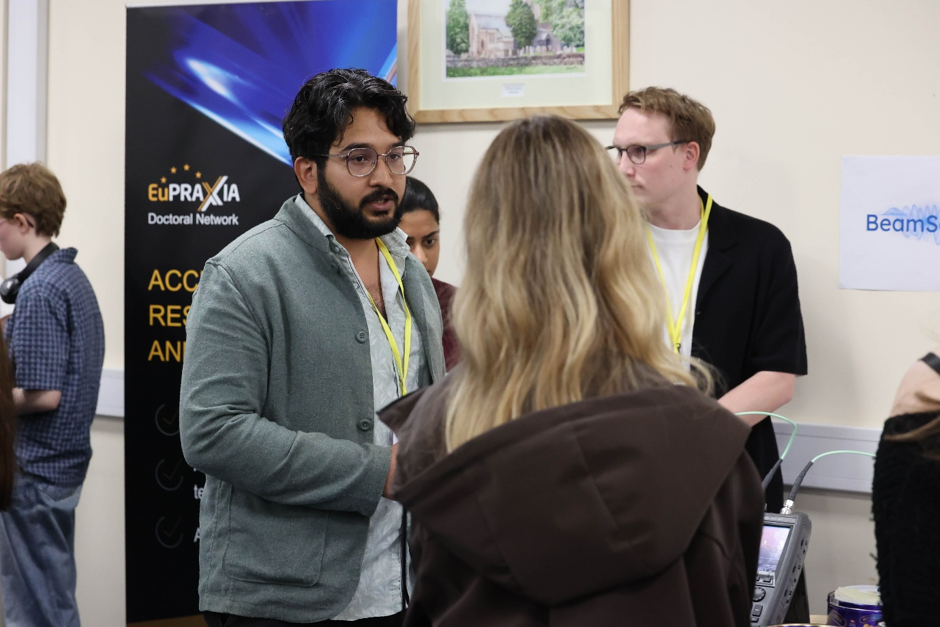
The teams were able to put these skills into practice with visiting A-level students. This gave the Fellows direct experience of adapting complex scientific ideas for non-specialists while encouraging the students to engage with accelerator science and the technologies associated with it.
A competitive element ran throughout the week, with the teams collecting points from the different challenges and activities. With the final scores combining performance across the programme, the competition remained extremely close until the end. Only five points separated the teams in the final standings, with Go Panthers! emerging as the overall winners of the challenge week.
By bringing together experimental physics, accelerator science, artificial intelligence and science communication, the week provided the EuPRAXIA-DN Fellows with an opportunity to develop a broad range of transferable skills while working collaboratively with colleagues from across the network.
Watch the videos:
Making the Invisible Visible: Schlieren Imaging System Setup | Beam Busters
RF accelerating cavity: a DIY science project | Beam Sense
We built a particle accelerator on a tabletop! | GoPanthers!