
Liverpool has placed itself at the forefront of efforts to make major scientific facilities, advanced technologies and research careers more sustainable.
The Innovations for a Sustainable Tomorrow symposium, held at The Spine on 10 July 2026, brought together leading scientists, policy experts, technology companies and early-career researchers to consider how sustainability should shape the next generation of research.
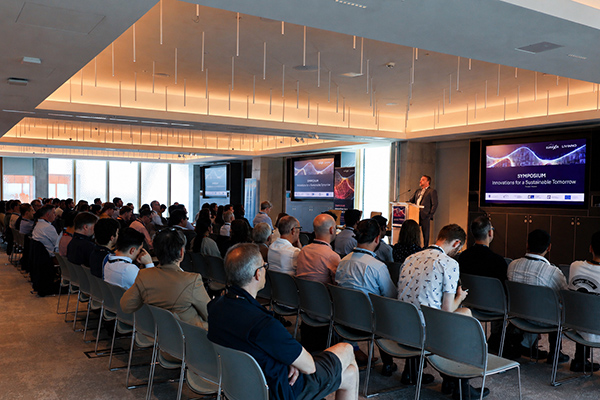
The event discussed the complete innovation chain, from the design and operation of advanced research infrastructures to artificial intelligence, medical technology, industrial partnerships and the training of future scientific leaders. It covered applications ranging from fundamental research, to medicine, electronics, energy and the environment.
Professor Welsch, CI expert and Head of Accelerator Science at Liverpool, said: “Sustainability must become a design principle for science, not an afterthought. In Liverpool, we are connecting novel acceleration techniques, artificial intelligence and advanced instrumentation to reduce energy and resource demands while increasing scientific and societal impact. We have a key role in defining this agenda with our international partners, and we are also training the experts who will deliver it.”
The symposium featured senior speakers from some of Europe’s leading scientific organizations. This included Professor Massimo Ferrario of INFN who delivered a keynote presentation on plasma-accelerator technology and the EuPRAXIA vision. In his talk he explained how radically more compact accelerator facilities could open new scientific and technological opportunities.

Aleš Hála, Head of ELI ERIC’s Innovation Office, discussed next-generation skills development, while Professor Richard Harding (STFC) examined partnerships between academia, industry and the public sector in the rapidly developing quantum-technology landscape.
The program placed Liverpool’s regional innovation ecosystem in an international context. John Whaling of the Liverpool City Region Combined Authority discussed the conditions needed to create a successful innovation ecosystem, which was followed by Dr Denise Völker (DESY), who focused on sustainable technologies for next-generation accelerators.
The program ended with an engaging panel discussion chaired by Prof Welsch about the future of sustainable technology. It featured Dr Lidia Borrell-Damián (Secretary General for Science Europe), Dr Massimo Noro (Director for Business Development for STFC) and, once again, Dr Völker of DESY.
Contributions from industry experts Dr James Cocks (Mirion Technologies), Dr Steve Wells (Adaptix) and Dr Sruthy Viswan (Amplitude) showed how cross-sector R&D can lead to practical technologies, including advanced radiation detectors, low-dose mobile 3D X-ray imaging and more sustainable lasers.
Liverpool researchers presented complementary case studies on intelligent sensors for accelerator operation, deep learning and real-time event reconstruction, and machine-learning-based beam-profile reconstruction. Together, these examples showed how smarter data use can improve experiment performance while reducing unnecessary computation, experimental time and resource consumption.
A central message from the event was that sustainability cannot be achieved by one discipline or organization working in isolation. By bringing different research communities together in Liverpool, the symposium created a forum in which sustainability could be considered from the outset.
An industry exhibition and poster session extended this discussion beyond the formal presentations, giving researchers, businesses and prospective partners opportunities to identify new projects and routes to application.

The scientific and training model showcased in Liverpool is fully aligned with the direction of government and international policy. The UK’s ten-year Industrial Strategy emphasizes research and development, technology adoption, business investment and the creation of highly skilled employment, i.e. exactly those areas that were addressed by the symposium.
At European level, improved researcher careers, infrastructures, international cooperation and technologies supporting the green and digital transitions are all strongly supported.
The symposium was made possible through the close relationship between Liverpool’s LIV.INNO Centre for Doctoral Training and the EuPRAXIA Doctoral Network. It brought research laboratories, universities, government bodies and businesses behind a shared sustainability agenda that will now shape future R&D.
All presentations can be accessed via the event website: