
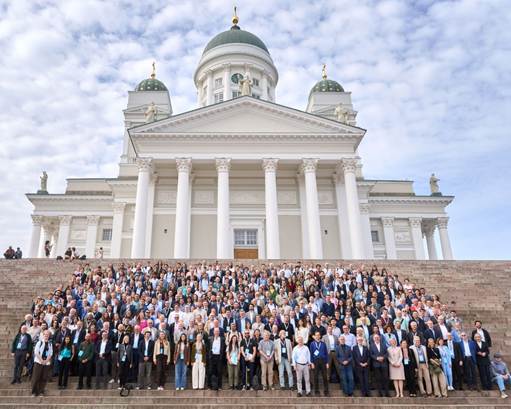
As FCC Week 2026 came to a close, the Future Circular Collider (FCC) community left Helsinki with renewed momentum and a strong sense of shared purpose. The week brought together 656 participants from across the world for a wide-ranging program of 66 public sessions, 265 oral presentations and 47 posters, covering precision physics, accelerator and detector R&D, sustainability, civil engineering, industry engagement, public dialogue and international collaboration.
Within this wider program, Tuesday 9 June featured the pre-kick-off meeting of iRIS, a new Horizon Europe project that will develop and demonstrate AI-powered sustainability solutions for large-scale research infrastructures. With a Horizon Europe grant of 5 M€ and a total project cost of 7.7 M€, iRIS will run for 50 months and brings together 12 beneficiaries and 12 associated partners, including major European research infrastructures, universities, research organizations and companies.
The project aims to turn research infrastructures into open innovation testbeds for technologies that reduce energy and resource use while accelerating the transfer of solutions from science to society. Its work is closely connected to future large-scale facilities, including the Future Circular Collider and the Einstein Telescope, and will support sustainability across the full lifecycle of research infrastructures: from design and construction to operation, reuse and long-term legacy.
Project Coordinator, Professor Johannes Gutleber (CERN) said: “iRIS will focus on high-technology-readiness solutions in areas including accelerator efficiency, non-intrusive load monitoring, real-time characterization and reuse of construction materials, soil restoration, and harmonized sustainability assessment using lifecycle, cost-benefit and socio-economic methodologies. These are extremely important for a next-generation accelerator like the FCC.”
CI expert Professor Carsten P Welsch (University of Liverpool), presented the project’s work package on Communication, Engagement and Inclusion. Led by Prof Welsch, WP6 will ensure that iRIS results reach diverse communities, from research infrastructure staff, industry, policymakers, educators, students all the way to the wider public. This includes developing a digital-first communication strategy, supporting open data and training resources, coordinating public and demonstration events, organizing school and university activities, supporting industry days and hackathons, and producing media materials that explain the project’s results and impact.
Professor Welsch said: “Liverpool’s role is to connect the consortium’s research with the communities that can benefit from it, ranging from research infrastructure teams and industry to policymakers, educators, students and the wider public. To maximize the overall impact of the project, it is extremely important to communicate all results in a strategic and structured way. We look forward to doing this with our international partners.”
For Liverpool Physics, participation in iRIS reflects a long-standing commitment to world-leading accelerator research, international collaboration and public engagement through the QUASAR Group and wider accelerator science cluster.
Further information: