
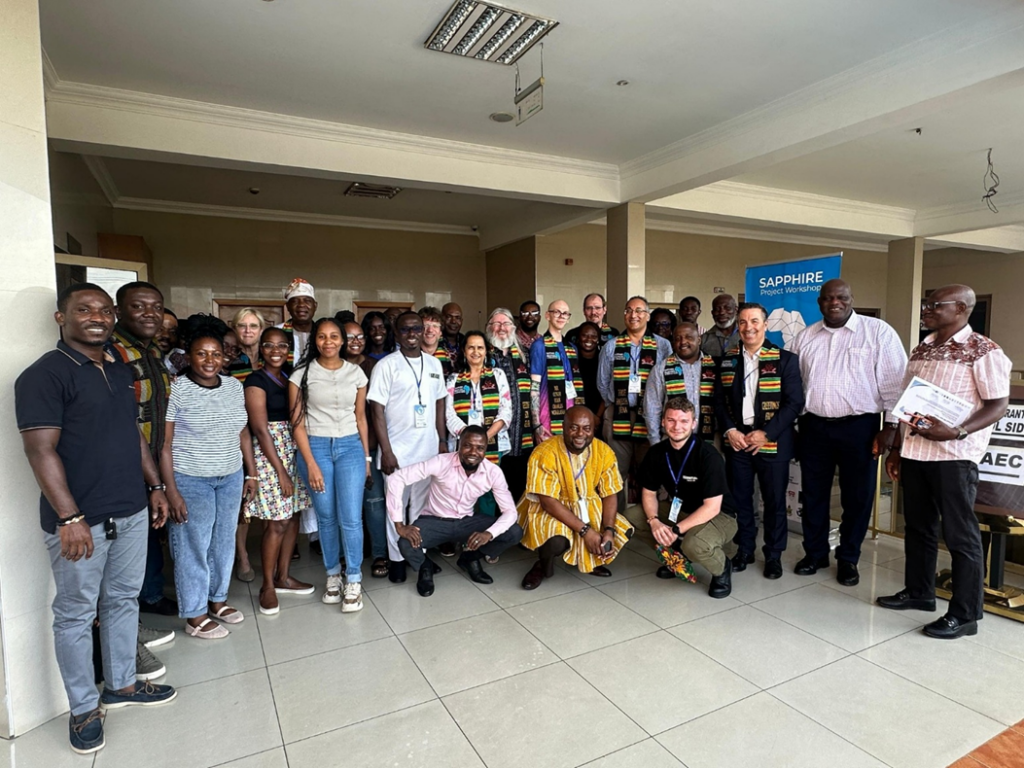
The Ghana Atomic Energy Commission (GAEC), through its Radiological and Medical Sciences Research Institute (RAMSRI), has successfully hosted a high-level international training workshop under the Supra-African Physics Partnership for Health Innovation and Radiotherapy Expansion (SAPPHIRE) Project. The week-long workshop, held from 13 – 18 April 2026 at the Mensvic Hotel in Accra, brought together leading experts and over 40 participants from Africa, Europe, and North America to strengthen radiotherapy capacity across the continent.
The SAPPHIRE Project, funded by the United Kingdom’s Science and Technology Facilities Council (STFC) under UK Research and Innovation (UKRI) and lead by Professor Manjit Dosanjh from University of Oxford, is a two-year initiative designed to address critical challenges in cancer care delivery in Africa. These challenges include the shortage of skilled medical physicists and engineers, limited access to advanced radiotherapy technologies, and the frequent breakdown of medical linear accelerator (LINAC) machines essential for cancer treatment.
Comprehensive Technical and Clinical Training
The workshop programme and its syllabus were coordinated by Prof Graeme Burt from the Cockcroft Institute / Lancaster University, with contributions from lecturers from both the UK and across Africa.
Accelerator-focused lectures were given by Prof Burt as well as CI expert Dr Rob Apsimon from Lancaster University, covering linac basics, RF cavities, beam dynamics, RF sources, beam-loading and radiation transport.
The workshop featured an intensive programme combining theoretical lectures, practical training sessions, and field-based learning experiences.
Each afternoon, Prof Burt ran linac simulation labs, using the commercial Simac code, where the students set-up, characterised and calibrated both Varian and Elekta medical linacs.
Prof Burt is also the project manager for the Sapphire project which includes a second workshop in South Africa in September and a programme of joint research on linac failure mechanisms and MLC analysis across the UK and the African partners.
Strengthening Africa’s Radiotherapy Workforce
The workshop served as a strategic platform for building human resource capacity and enhancing technical expertise in radiotherapy. Participants included medical physicists, clinicians, engineers, and researchers drawn from Ghana, South Africa, Nigeria, Kenya, Rwanda, Uganda, the United Kingdom, Canada, and the United States.
Delivering the official opening address, the Acting Director-General of GAEC, Prof. Francis Hasford, underscored the urgent need for sustainable investment in human capital to complement infrastructure development in cancer care.
“Reliable cancer treatment depends not only on equipment availability but also on the presence of skilled medical physicists, engineers, and technical professionals who can operate and maintain complex systems effectively,” he stated.
Prof. Hasford further highlighted the importance of international collaboration, noting that the SAPPHIRE Project provides a unique framework for technology transfer, research cooperation, and shared learning between African institutions and global leaders in accelerator science and medical physics.
He emphasized that the initiative aligns with Ghana’s national cancer control strategy and broader continental efforts to ensure equitable access to life-saving radiotherapy services.
A Timely Response to Africa’s Growing Cancer Burden
In her welcome address, the Director of RAMSRI, Dr. Theodosia Adom, described the SAPPHIRE Project as a timely and strategic intervention in response to the increasing burden of cancer in Africa.
She highlighted GAEC’s longstanding contribution to healthcare delivery through nuclear science applications, including medical physics research, radiation protection, radiobiology, nuclear medicine, and professional training.
Dr. Edom noted that despite growing demand for cancer treatment, many African countries continue to face significant barriers, including inadequate infrastructure, equipment downtime, and a shortage of trained specialists.
“By strengthening technical capacity in accelerator science and improving the operational performance and sustainability of medical linear accelerator systems, the SAPPHIRE Project directly addresses some of the most critical barriers to effective cancer treatment delivery,” she said.
Building Sustainable Solutions for Africa
The SAPPHIRE workshop concluded with a strong call for sustained investment in training, research collaboration, and infrastructure development.
They also advocated for follow-up workshops and the expansion of the SAPPHIRE initiative to ensure long-term impact and continuity.
By fostering collaboration, strengthening technical capacity, and promoting knowledge exchange, the SAPPHIRE Project represents a significant step toward improving access to safe, reliable, and effective cancer treatment services across Africa.