
Researchers, accelerator experts, and industrial stakeholders from across Europe gathered at Technische Universität Darmstadt on 7–8 May 2026 for the ARTIFACT-DN Workshop, a strategic meeting dedicated to preparing a competitive proposal for a new Marie Skłodowska-Curie Doctoral Network (MSCA-DN) under the upcoming RAISE call.
Building on the momentum of the ARTIFACT ecosystem and several recently funded Horizon Europe initiatives, the workshop marked an important step towards the development of ARTIFACT-DN, an ambitious European training network focused on advancing artificial intelligence for next-generation particle accelerators and large-scale research infrastructures.
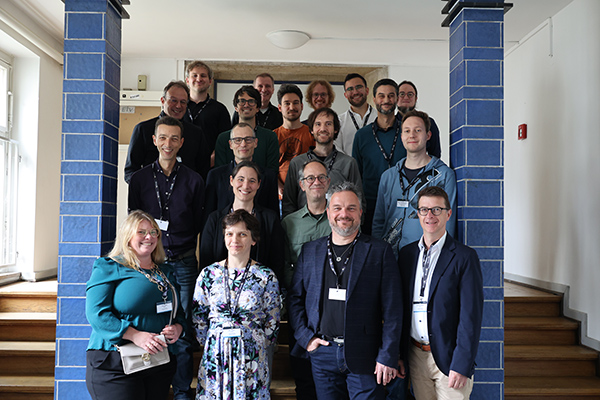
The proposed Doctoral Network will train a new generation of doctoral researchers at the interface of accelerator physics, advanced artificial intelligence, and research infrastructure engineering. ARTIFACT-DN aims to address some of the most pressing challenges facing accelerator facilities worldwide: how to use cutting-edge AI technologies to design, operate, optimize, and sustain increasingly complex accelerator infrastructures.
The scientific program discussed during the workshop was structured around three interconnected research pillars: AI-driven accelerator design, operation and applications. Alongside scientific excellence, the network will provide comprehensive interdisciplinary training, transferable skills development, and strong exposure to industrial and operational environments through secondments and collaborative projects.
The two-day program featured interesting discussions on the scientific work packages, doctoral training strategy, as well as best practice in communication and dissemination activities, presented by Alexandra Welsch. Sessions also explored synergies with existing European initiatives including the recently funded TWINRISE, EPITA and iRIS projects.
Professor Carsten Welsch, organizer of the workshop and Coordinator of the planned ARTIFACT-DN proposal, highlighted the importance of the initiative: “Artificial intelligence is rapidly transforming how we design and operate accelerator facilities. Through ARTIFACT-DN, we aim to build a new European training network that equips 15 doctoral candidates with the skills needed to drive innovation in accelerator science and research ‘sinfrastructures for decades to come. The excellent discussions in Darmstadt demonstrated the strong commitment across Europe to jointly shape this vision.”
Prof Welsch expressed his sincere thanks to the local hosts led by Professor Oliver Boine-Frankenheim and colleagues at TU Darmstadt for their excellent hospitality and support throughout the meeting. Special thanks were also extended to the QUASAR Group’s Project TEAM for the help in preparing the workshop.